
How to Check Criminal History in Tulare County
Start with the record that answers the question. The Tulare Superior Court Online Case Index is the main county source for filed charges, hearings, dispositions, and sentences. The Sheriff's active inmate system is for present custody and recent booking information. An incident report stays with the sheriff, Visalia Police, Tulare Police, Porterville Police, CHP, or other agency that wrote it. A statewide personal record requires fingerprints through California DOJ.
Gather the full name, date of birth, spelling variants, and any case, report, or booking number. A name match alone can point to the wrong person. Court files are organized by case number, jail entries by booking, and DOJ records by fingerprints. Search results should be checked against dates, charges, and the originating office before they are treated as reliable.
- Search the court index for a filed Tulare County criminal case and note the case number.
- Check current custody through the Sheriff's inmate channel when an arrest is recent.
- Request the incident report from the agency that made the arrest or took the call.
- Compare arrest charges with the complaint, disposition, and sentence in the court file.
- Use DOJ Live Scan to review your own statewide record or challenge a missing outcome.
Four Tulare Record Systems
Tulare County criminal records do not sit in one public database. A police or sheriff report starts the record. Jail intake then creates a booking number, custody status, bail entry, and charge list. The District Attorney reviews the reports and may file charges that differ from the arrest allegations. The Superior Court creates the case, minutes, hearing dates, disposition, sentence, and financial orders.
Fingerprints and later outcomes should reach the California Department of Justice repository. Reporting gaps can occur, and DOJ may contact a court or prosecutor to resolve a missing disposition. That explains why a jail lookup, court index, incident report, and DOJ rap sheet may show different facts without any source being a full substitute for another.
| Question | Best official source | What it does not prove |
|---|---|---|
| Was a case filed? | Tulare Superior Court | Complete statewide history |
| Is someone in county custody? | Sheriff active inmate search | Prior arrest history |
| What did an officer report? | Arresting agency records unit | Final guilt or sentence |
| What is on my California rap sheet? | DOJ fingerprint record review | Every underlying case document |
The official county gateway shows how agencies divide their work. The captured Tulare County portal leads to county departments and services.
Use it to confirm the office responsible for a county-held record.
Official California Background Checks
California's official statewide criminal-history process is fingerprint based. A California resident reviewing their own record completes BCIA 8016RR and visits an approved Live Scan location with valid photo identification. The California DOJ Record Review costs $25 for DOJ processing unless a fee waiver is approved, and the fingerprint provider charges a separate rolling fee.
There is no general California DOJ public name portal for obtaining another person's rap sheet. Statutorily authorized applicant-agency checks follow their own official process. A personal record-review request may not be submitted as a third-party search. After results arrive, a person can use BCIA 8706 to challenge an alleged error or missing disposition.
| Service | Official fee | Key point |
|---|---|---|
| California own-record review | $25 DOJ fee | Live Scan rolling fee is extra |
| Fee waiver | May waive DOJ fee | Provider fee may remain |
| Tulare court copy | $0.50 per page, per side | Public case documents only |
| Certified criminal copy | $40 plus pages | Ordered from Superior Court |
The DOJ record-review capture shows the official personal-review route.
It is the proper statewide source when county records appear incomplete.
V and P Case Routing
Tulare Superior Court uses a practical prefix rule for mailed copy requests. Case numbers beginning with “V” route to Civil/Criminal Records at 221 S. Mooney Boulevard in Visalia. Numbers beginning with “P” route to the South County Justice Center at 300 E. Olive Avenue in Porterville. This is a copy-routing rule, not a promise that every local case uses the same detailed format.
If the number is unknown, use the online index, the public terminals in Visalia Rooms 124 and 201, or ask the clerk to search. A search taking more than ten minutes costs $15. Online requests prompt staff contact within 24 to 48 hours, while mail and email copy requests are generally processed within 15 business days after the request and payment arrive.
The court's online services page presents both case-index and record-request paths.
A portal result is a lead. A certified copy comes from the clerk.
Types of Criminal Records
Tulare County criminal history includes several distinct records. Arrest and incident reports come from the law-enforcement agency. Jail bookings come from the Sheriff's Detentions Division. Complaints and indictments begin filed cases, while the Superior Court keeps motions, pleas, minutes, outcomes, and sentences. DOJ compiles fingerprint-linked state summary history under Penal Code 11105.
Warrants originate with courts and are enforced by law enforcement. Probation is county run, parole is handled by CDCR, and state-prison custody appears in CIRIS. The California Megan's Law Website displays only registry information allowed by law. Each source has its own access limits.
- Arrest and booking records: allegations, intake data, bail, facility, and custody status.
- Criminal court files: filed charges, hearings, pleas, orders, dispositions, and sentence.
- DOJ rap sheets: restricted fingerprint-based state summary criminal history.
- Warrants: court orders tracked or served by law enforcement.
- Supervision and registry records: limited probation, parole, custody, or public registry facts.
Sheriff Records Requests
The Tulare County Sheriff's Records Department is the first stop for incidents handled by deputies in unincorporated areas and for nonexempt sheriff records. Requests may be made by email at SheriffRecords@tularecounty.ca.gov or by phone at (559) 802-9400. Give a report number when possible, plus the date, location, people involved, and a precise description of the record.
The California Public Records Act does not turn a police file into an open rap sheet. Juvenile information, victim and witness details, confidential sources, active-investigation material, and local summary criminal history may be withheld or redacted. City incidents should go to the city police records unit that created the report.
Sheriff's Records Department
Email: SheriffRecords@tularecounty.ca.gov
(559) 802-9400
Incident reports and CPRA requests
Superior Court Records
221 S. Mooney Blvd., Visalia
300 E. Olive Ave., Porterville
Filed cases and certified copies
The Sheriff's official web material shows the county records context.
Always direct a request to the agency that made the record.
What a Tulare County Criminal Record Shows
Fields depend on the source. A court file is organized around a case and its docket. A booking entry centers on custody. A DOJ rap sheet links arrests and reported outcomes to fingerprints. Similar labels can have different meanings, so read the source name, update date, and status with each entry.
| Name & Identifiers | Name, birth date, physical description, fingerprints, aliases, or case party data, depending on access. |
|---|---|
| Arrest / Booking Data | Arrest date, agency, booking number, alleged charges, bail, facility, and release status. |
| Charges & Statutes | Arrest allegations or the separate charges filed by the District Attorney. |
| Disposition | The outcome of each charge, such as dismissal, conviction, or acquittal. |
| Sentence | Jail, prison, probation, fines, restitution, or other court orders. |
| Custody / Supervision Status | Current county jail, CDCR custody, probation, parole, or release information when public. |
Booking Photos Have Limits
The Sheriff's booking-photo policy makes the active inmate channel a current-custody tool, not an arrest archive. Public booking data may include name, birth date, physical description, arrest details, booking number and date, charges, bail, scheduled release, facility, and a booking photograph while the person remains in custody.
The Sheriff does not release prior arrest history through that channel. A photo may disappear after release, and an arrest charge may later be changed or rejected by the District Attorney. For recent custody use the inmate search; for a filed outcome switch to the court case. For your full state record use DOJ fingerprint review.
The Superior Court homepage is the official path once a prosecution becomes a filed case.
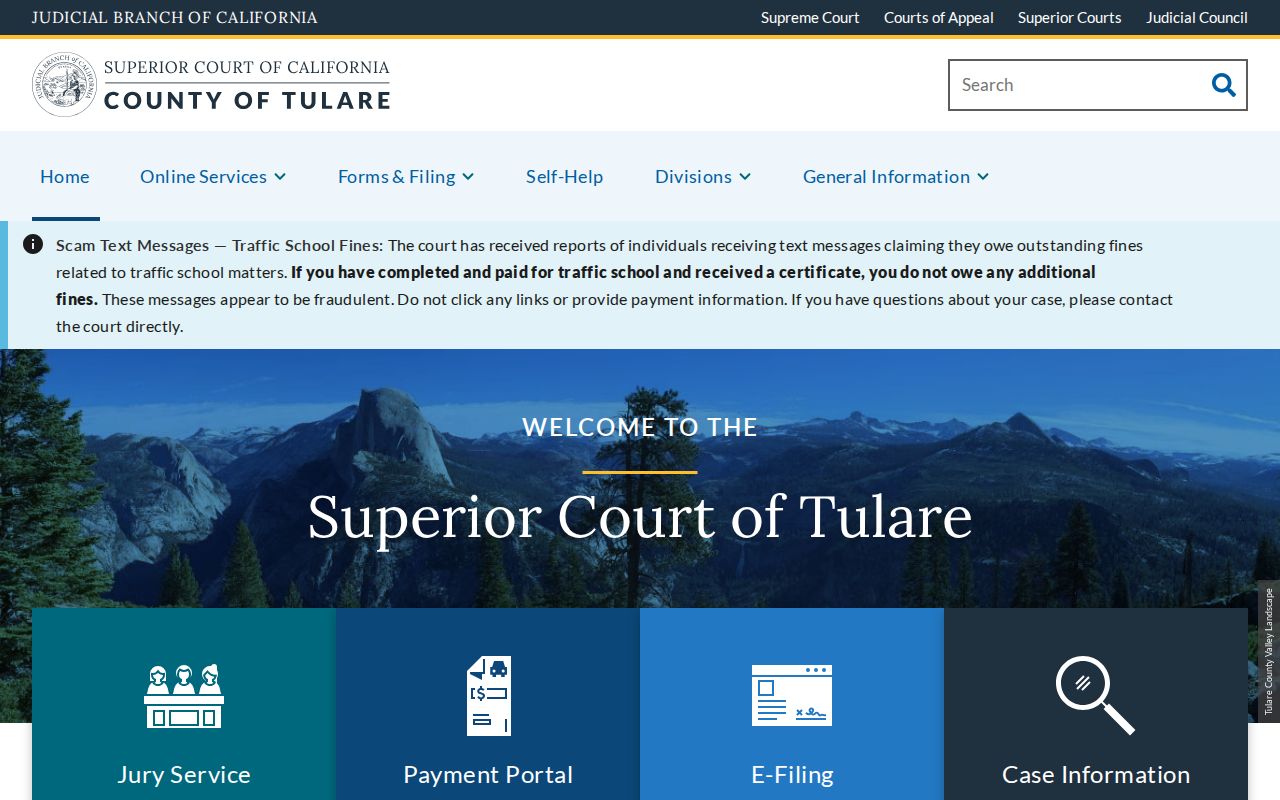
Custody information is never proof of guilt.
Public Access Laws
The California Public Records Act allows inspection of nonexempt state and local records. It does not override the separate limits on summary criminal history, juvenile files, victim information, or active investigations. Tulare court documents are generally public unless sealed, confidential, destroyed, or otherwise restricted, while police reports often require redaction.
Key Statutes:
Government Code 7920.000 starts the California Public Records Act framework for nonexempt agency records.
Penal Code 11105 defines state summary criminal history and limits DOJ disclosure.
Penal Code 13300 limits disclosure of local summary criminal history.
Penal Code 851.91 provides a petition route to seal qualifying arrests.
Penal Code 1203.4 provides common post-probation dismissal relief.
Arrest Charges Can Change
The arresting agency records the initial allegations. The Tulare County District Attorney then reviews police reports and decides whether to file a complaint. A grand jury indictment is another, less common path. The filed complaint may omit, add, or change an arrest charge, so the court file is the best public source for what the prosecution actually brought.
From filing, the case can move through arraignment, pretrial motions, a felony preliminary hearing, plea discussions, trial, disposition, and sentencing. The DA's local court-system explanation defines those steps. The Public Defender also maintains custody, court-status, and record-clearing resources.
- Complaint
- The prosecutor's filed charging document.
- Arraignment
- The hearing where charges are stated and a plea is entered.
- Disposition
- The current or final outcome of a charge.
- Expungement
- Common California wording for Penal Code 1203.4 dismissal relief, not total erasure.
The DA homepage capture represents the charging office's official channel.

Compare its filed case with the court docket, not just the booking entry.
Sealed, Expunged, and Restricted Records
Restricted Tulare County records include juvenile delinquency files, sealed arrests, nonpublic DOJ rap sheets, victim details, confidential-source information, sensitive identifiers, and material that could harm an active investigation. A missing public result can mean restriction, but it can also mean the wrong name, a data delay, an archived file, or a case that was never filed.
California offers several forms of relief. Penal Code 1203.4 provides dismissal relief commonly called expungement. Penal Code 851.91 permits petitions to seal qualifying arrest records. Sections 851.93 and 1203.425 provide automatic relief for eligible arrests and convictions. Relief does not erase every trace or bar all authorized access. Get the case number, match the arrest to its disposition, choose the proper remedy, file in the correct Tulare court division, and verify later updates with the court and DOJ.
The Public Defender publishes local record-clearing resources.
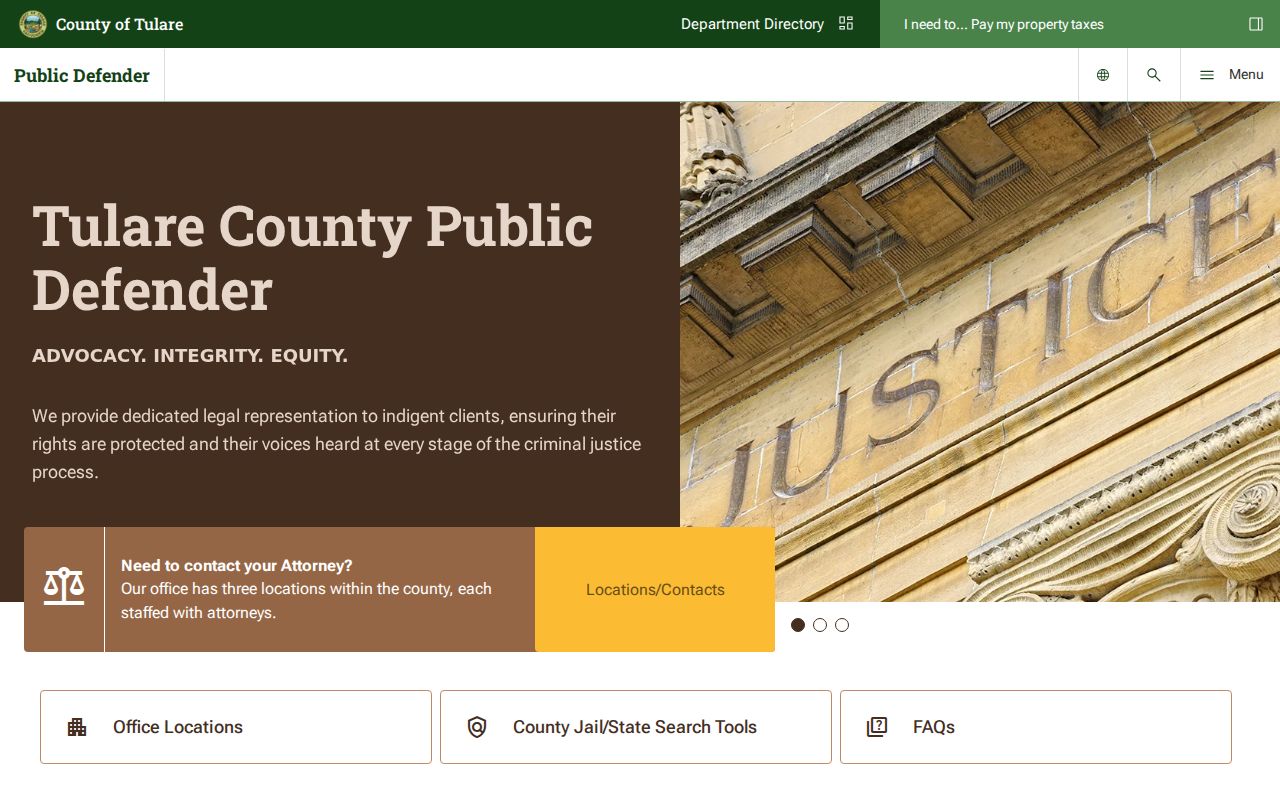
Certified orders can help when an agency record has not caught up.
No Universal Warrant Search
No official countywide public warrant-search portal was found in the Tulare research. The Sheriff's Top Ten Most Wanted list and news releases cover selected fugitives, not every active warrant. A bench warrant often arises after a person misses court or disobeys an order, while other warrants may come from an investigation.
For your own possible court warrant, check the Superior Court case and contact the proper criminal clerk. Sheriff records or fugitive contacts may help with law-enforcement questions, but sensitive warrant facts can be withheld. Do not rely on a commercial arrest or people-search site. An outstanding warrant can lead to arrest, so legal advice may be prudent before appearing in person.
Urgent: A web search cannot clear a warrant. Only the issuing court or authorized law-enforcement process can resolve it.
The court portal capture shows the official county case-index entry point.
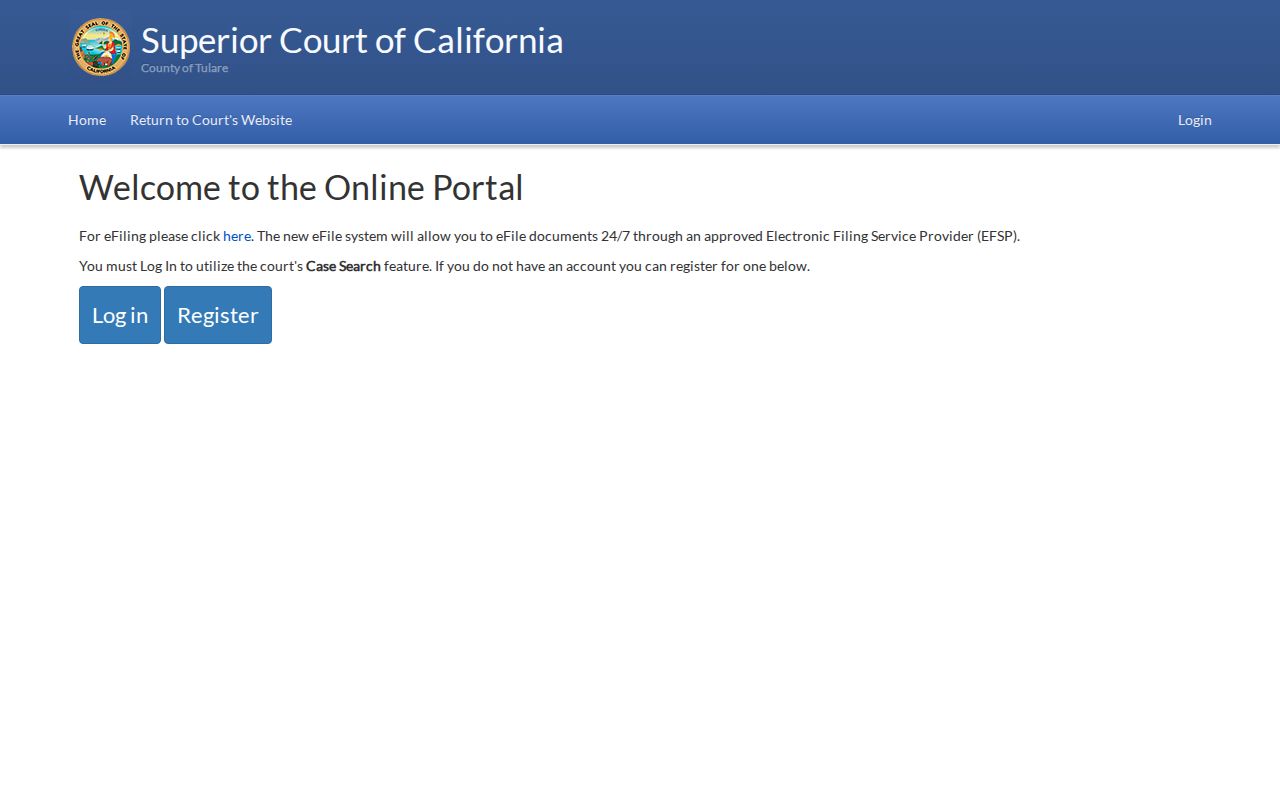
Verify the case number before requesting documents or taking action.
Probation's Mobile Service Center
Tulare County Probation is county run, while parole is handled by the California Department of Corrections and Rehabilitation. The county launched what it described as California's largest Mobile Service Center on June 2, 2025. It began at Dinuba Library and Ledbetter Park in Cutler, then expanded to eight more locations with Wi-Fi, private workstations, and video links for appointments and support.
That program shows why probation status is not a simple public name lookup. Court files may show a probation sentence or violation hearing, while officer notes, risk assessments, and treatment records may remain confidential. For state-prison custody use CDCR CIRIS. For county supervision questions, use Tulare County Probation at (559) 608-9000.
The court records-request image shows the document channel for supervision orders filed in a case.
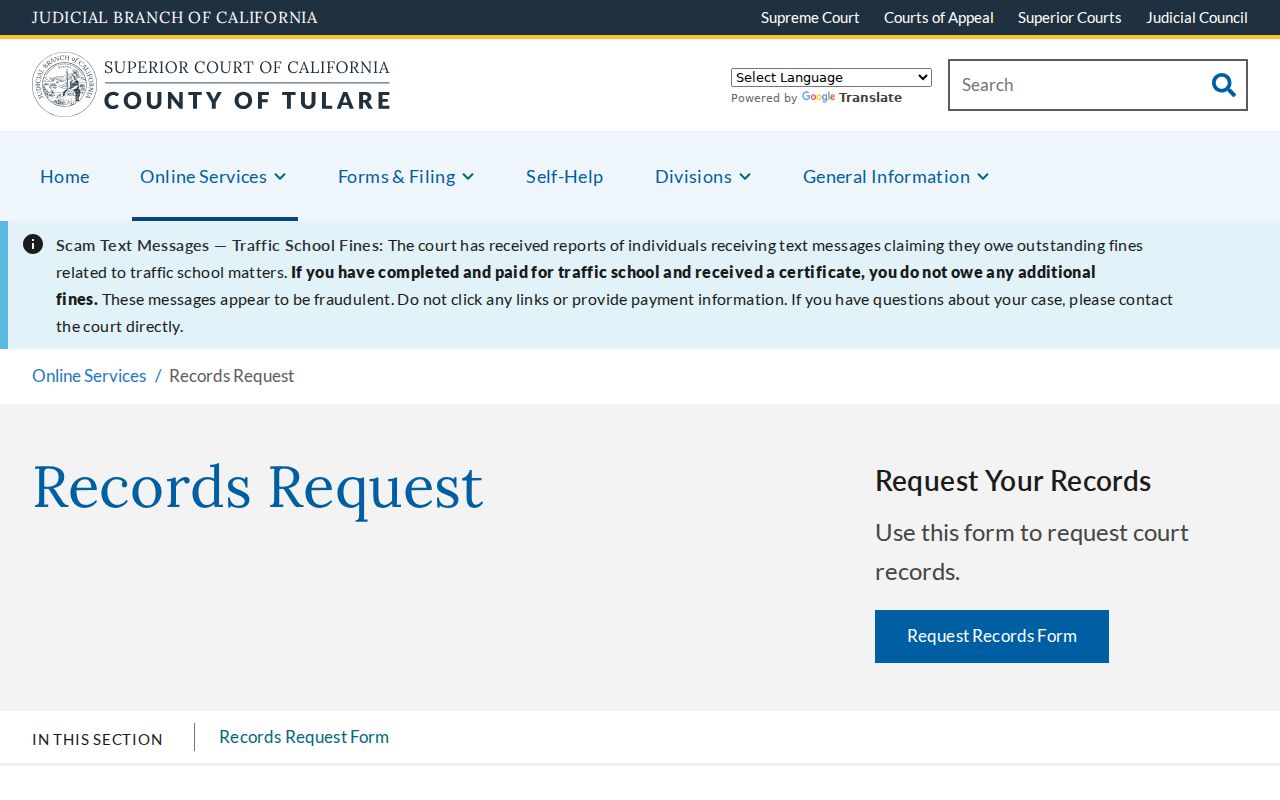
Court orders and private supervision files are not the same record.
Criminal Records by City in Tulare County
City police departments create their own incident and arrest reports, but criminal prosecutions move into the county Superior Court. Visalia offers a detailed Records Unit and NextRequest portal. Tulare Police lists a direct Records/Reports line. Porterville Police handles city incidents, while P-prefix court copies route to the South County Justice Center. These city guides keep the local first step clear without treating a city report as a full Tulare County criminal history.
Visalia Criminal History
146,541 · Police records, NextRequest, and V-prefix court routing
Tulare Criminal History
68,926 · Tulare Police records and county court filing routes
Porterville Criminal History
62,983 · Police reports and South County Justice Center copies
Records Across a Large County
Tulare County covers 4,839.09 square miles and had an estimated 485,146 residents in 2025. Its justice records reflect that scale. Visalia is the main civic and court-records hub. Porterville's South County Justice Center serves the south county. Dinuba provides limited criminal and traffic payment service. Separate pretrial and juvenile facilities add more locations.
The geography matters when requesting copies or trying to identify the office behind a record. A police report stays with the city or sheriff agency, a jail entry stays with Detentions, and a filed case follows Superior Court routing. Confirm the case prefix and record holder before mailing payment or traveling to a counter.